- Home
-
Hochschule
- Aktuelles
-
Profil
- Zahlen, Daten, Fakten
- Selbstverständnis der HSBI
- Qualitätsverständnis
- Leitbild Lehre
- Lehrpreis
- Netzwerk Innovatives Lehren und Lernen (InnoLL)
- Prozessmanagement
- Familiengerechte Hochschule
- Diversity
- Weltoffene Hochschule
- Strategie Internationales
- Nachhaltigkeit
- Rückblick: 50 Jahre FH Bielefeld
- Feedback
- Fachbereiche
- Zentrale Organisation
- Standorte / Anfahrt
- HSBI-Portale
-
Studium
- Studienangebote
-
Beratung
- Studienorientierung
- Zentrale Studienberatung
- Studienfachberatung
- Psychosoziale Beratung
- Studienfinanzierung und Stipendien
- Schreibberatung
- Studieren mit beruflicher Qualifikation
- Studieren mit ausländischen Zeugnissen
- Studieren mit Handicap
- Studieren mit Familie
- Informationen für Schulen
- Auslandsaufenthalt
-
Bewerbung
- Auswahlgrenzen und Vergabeverfahren (NC)
- Bewerbungsportal
- Bewerbung Schritt für Schritt: Von der Bewerbung bis zur Einschreibung
- Bewerbung für ein höheres Fachsemester
- Bewerbung mit beruflicher Qualifikation
- Jungstudierende
- Gasthörerschaft und Zweithörerschaft
- Kontakt Studierendenservice
- Losverfahren
- Promotion
- Sonderanträge
- Studiengang wählen
- Wer kann an der HSBI studieren?
- Studienstart
-
Studium organisieren
- Studierendenservice
- Abschlussunterlagen
- Anerkennung von Leistungen
- Anträge einreichen
- Beurlaubung
- CampusCard
- Einreichung schriftliche Arbeiten
- Erstattung
- Exmatrikulation
- IT-Services
- Online-Serviceportale (LSF/CAT)
- Prüfungsangelegenheiten: Ordnungen, Modulhandbücher
- Rücktritt von einer Modulprüfung
- Rückmeldung
- Semesterbeitrag
- Semesterticket (Deutschlandsemesterticket)
- Semester-, Vorlesungs- und Prüfungszeiten
- Studienbezogene Auslandserfahrung
- Vorlesungsverzeichnis
- Rund ums Studium
- Fachbereiche
- Forschung
- Transfer
- Weiterbildung
- Internationales
- Karriere an der HSBI
Shaping the Exchange between Science, Business, Politics and Society: International Business Conference BiCAB Provides Insights)

At the invitation of HSBI’ Bielefeld School of Business, international and national experts from politics, business and science gathered at the fifth BiCAB Conference to discuss the importance of shaping the exchange between science, business, politics and society. They also talked about how this exchange can be further strengthened
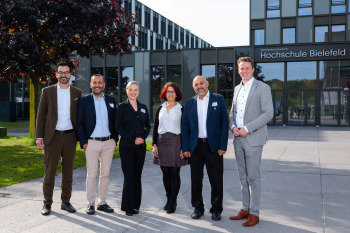
Bielefeld (HSBI). Social change results from building bridges between knowledge, ideas and technological transfer – one cannot be without the other and vice versa. Transfer is not a one-way street leading from science into the companies. It is a dynamic and mutual system. The fourth Bielefeld International Conference on Applied Business (BiCAB), organised by HSBI’s Bielefeld School of Business, focused on how the exchange between politics, business, science and society can be further strengthened. About 60 participants from science, companies and studies gathered under the motto “Bridges for Impact: Linking Science, Economy, Politics, and Society.”, listened to keynote presentations and discussed the topic. As in the previous years, the conference took place within HSBI’s International Week.
Prof. Dr. Riza Öztürk, Dean of HSBI’s Bielefeld School of Business, and Prof. Dr. Natalie Bartholomäus, Vice President Transfer and Societal Impact, welcomed the participants with a suitable anecdote. “There is a newspaper article hanging in my office from 12 years ago. The article says that Riza and I were keen on building the first bridges for third mission activities – only that it wasn’t called third mission back then,” said Prof. Dr. Bartholomäus. “And now look at us. 12 years on, we stand here, fighting for just that.”
Prof. Dr. Bartholomäus and Prof. Dr. Öztürk still want to strengthen those bridges and build some more: “Bridges are good if they are used,” says Prof. Dr. Öztürk. “And the BiCAB Conference is a starting point for strong partnership.”
More trust, less bureaucracy
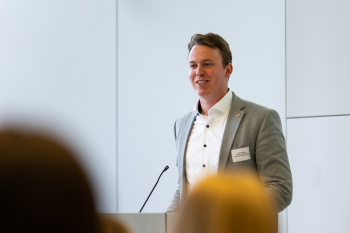
The department was able to have Tom Brüntrup, a CDU Member of the Landtag representing Bielefeld, for the keynote presentation. Brüntrup spoke on the topic of “Communication and Cooperation as a Competitive Advantage” from the perspective of politics. He explained the challenges that politicians must address. He spoke of excessively long application procedures for research projects, financial budgets determining which projects are prioritised, limited practical research and limited funding periods. Brüntrups conclusion was: “We need more trust in our universities and less bureaucracy.”
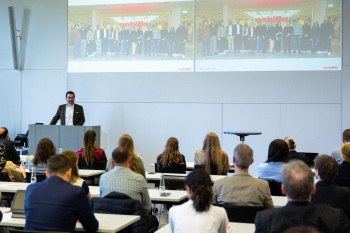
Şafak Kibar, Head of Production Controlling, Process Optimization and Business Intelligence Production and Logistics at Nobilia, was the second keynote speaker. Through Nobilia, Kibar has been a partner of HSBI for a long time now. He already participated in the European Summer School and most recently attended a joint research school with lecturers and researchers of HSBI in Istanbul in March. Kibar emphasised the advantages of the cooperation. “We benefit from each other. Through these cooperations, we get to know the people who will later become our colleagues. Plus we work on some great joint projects together.”
Prof. Dr. José Alejandro Velázquez Montes had travelled from Mexico. He is a full professor for landscape ecology at Universidad Nacional Autónoma de México (UNAM). In his presentation “Reframing the role of universities as cooperation alliances for equality, prosperity and peaceful societies”, he also highlighted the importance of fostering collaboration between science, politics and society: “The bridges we build should have an impact.” The world of science has undergone constant change in recent years – particularly as a result of social media –, but it has experienced an upsurge since the start of the Corona pandemic in 2020. He also emphasised the importance of universities: “We shape the people who will become leaders.”
Prof. Dr. José Alejandro Velázquez Montes had travelled from Mexico. He is a full professor for landscape ecology at Universidad Nacional Autónoma de México (UNAM). In his presentation “Reframing the role of universities as cooperation alliances for equality, prosperity and peaceful societies”, he also highlighted the importance of fostering collaboration between science, politics and society: “The bridges we build should have an impact.” The world of science has undergone constant change in recent years – particularly as a result of social media –, but it has experienced an upsurge since the start of the Corona pandemic in 2020. He also emphasised the importance of universities: “We shape the people who will become leaders.”

Panel discussion: “Universities should seek to engage with society”
The following panel discussion made it clear that greater transparency and trust are needed to ensure good collaboration between everybody involved. Velázquez Montes emphasised that “universities must step out of their ivory tower and seek engagement with society.” The challenges are that the stakeholders speak different languages and discuss different topics. “Therefore, I would like to see stakeholder workshops in which communication and collaboration creates a competitive advantage for the OWL region,” said Tom Brüntrup. Kibar emphasised that papers and other university publications should be accessible and thus usable to companies and the wider economy.
Awards for the best papers
In the academic section of the conference, professors, researchers and students from HSBI and other international universities presented a total of eleven papers. The two best papers were selected by a jury and the audience and the winners received 500 euros each: First place went to Prof. Dr. Ela Sibel Bayrak Meydanoğlu, Hilmi Berkay Abbasoğlu (PhD) (both from Turkish-German University), Dr. Ahmet Mete Çilingirtürk (Marmara University), Prof. Dr. Paul F. Langer (Worms University of Applied Sciences) and Prof. Dr. Margareta Teodorescu (Koblenz University of Applied Sciences) with their paper “AI-Enabled Multimodal Science Communication: Reducing Cognitive Load and Enhancing Comprehension of Complex Research.”
Awards for the best papers
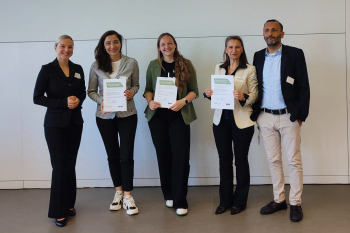
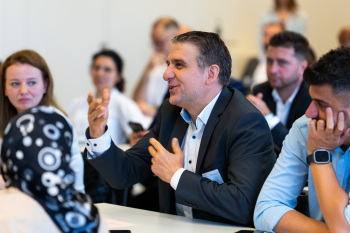
In the academic section of the conference, professors, researchers and students from HSBI and other international universities presented a total of eleven papers. The two best papers were selected by a jury and the audience and the winners received 500 euros each: First place went to Prof. Dr. Ela Sibel Bayrak Meydanoğlu, Hilmi Berkay Abbasoğlu (PhD) (both from Turkish-German University), Dr. Ahmet Mete Çilingirtürk (Marmara University), Prof. Dr. Paul F. Langer (Worms University of Applied Sciences) and Prof. Dr. Margareta Teodorescu (Koblenz University of Applied Sciences) with their paper “AI-Enabled Multimodal Science Communication: Reducing Cognitive Load and Enhancing Comprehension of Complex Research.”
The other winners were Prof. Dr. Manuel Stegemann and Jana Dreischalück from HSBI with their topic “Who Is Ready to Ride? Understanding User Profiles to Foster Acceptance of Autonomous Rail Vehicles.” (sab/nk/abo)
Kontakt
